
Akoya are the classic round, mirror-bright pearls most people picture when they think of a pearl strand. This guide covers how everyday, uncertified Akoya are graded, what lab certification adds, and the rare natural blue Akoya.
What are Akoya pearls?
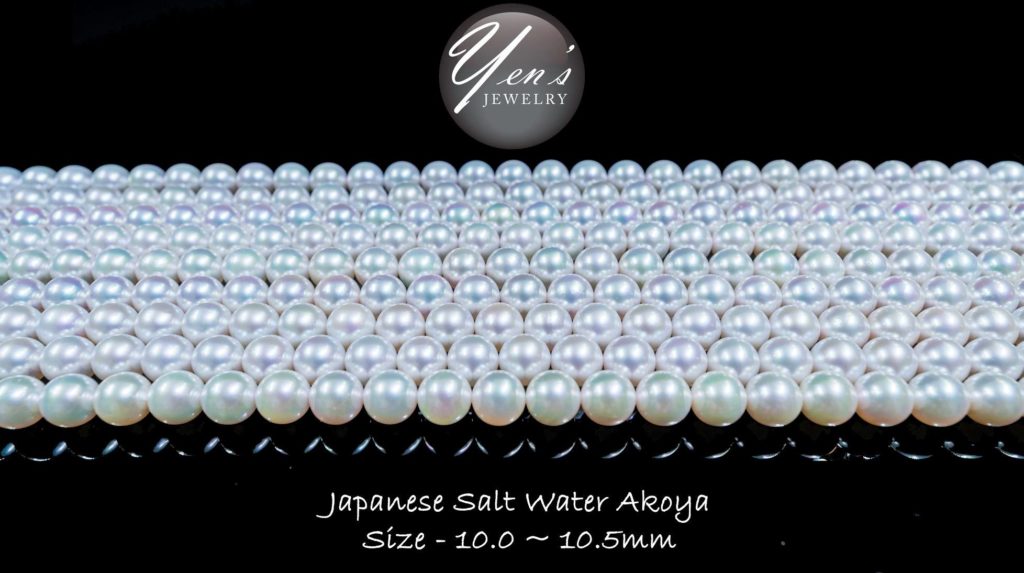
Akoya were the first bead-nucleated cultured pearls. A shell bead is placed in the oyster, which coats it in nacre over a growing season or two. Because the Akoya oyster is small, the pearls are too: most run 6–8 mm, and anything above 10 mm is rare. Akoya are usually very round, with a sharp, mirror-like luster and white bodies carrying rosé, silver or cream overtones.
Akoya nacre is thin compared with South Sea or beaded freshwater pearls, often a fraction of a millimeter. That’s why nacre thickness matters more in Akoya grading than in any other type, and why luster and surface do so much of the work.
Uncertified Akoya: what A, AA and AAA mean
Most Akoya sold is not lab-certified. Dealers grade it themselves, usually on an A to AAA scale, sometimes with steps in between such as AA+ or AAA+, or house names like “Gem.”
As a rough guide, this is how the letters are commonly used:
| Grade | Typically means |
|---|---|
| A | Softer luster, visible blemishes and more off-round pearls. An entry grade. |
| AA | Good luster with some blemishes; mostly round. A common mid-range grade. |
| AAA | High luster, clean surfaces, round and closely matched. A seller’s top grade. |
| AAA+ / Gem | Some sellers add a step above AAA for their very best strands. |
What makes a fine Akoya
| Factor | What to look for |
|---|---|
| Luster | The most important factor: sharp, bright reflections you can see your face in |
| Surface | Fewer and smaller blemishes; under a strand’s own weight, look where pearls touch |
| Shape | Round is the standard for Akoya; off-round pearls are priced lower |
| Nacre | Thicker nacre lasts longer and glows more; thin nacre can look chalky or show the bead |
| Color and overtone | White with rosé overtone is the classic; silver and cream are also common |
| Matching | Pearls in a strand should agree in size, color, luster and shape |
| Size | Value climbs steeply above 8 mm, and above 10 mm is rare |
In the press: GIA featured our 11–12 mm Japanese Akoya strands, which took more than one harvest to match.
PSL certified Akoya
Pearl Science Laboratory (PSL) issues the trade’s most widely recognized standardized grading for Akoya. Its certified tiers for white Akoya, from entry level to the top, are Rose, Premium Rose, Hanadama and Tennyo. Each comes with a numbered report, so the grade is tied to a specific strand rather than a seller’s say-so.
Natural blue Akoya pearls
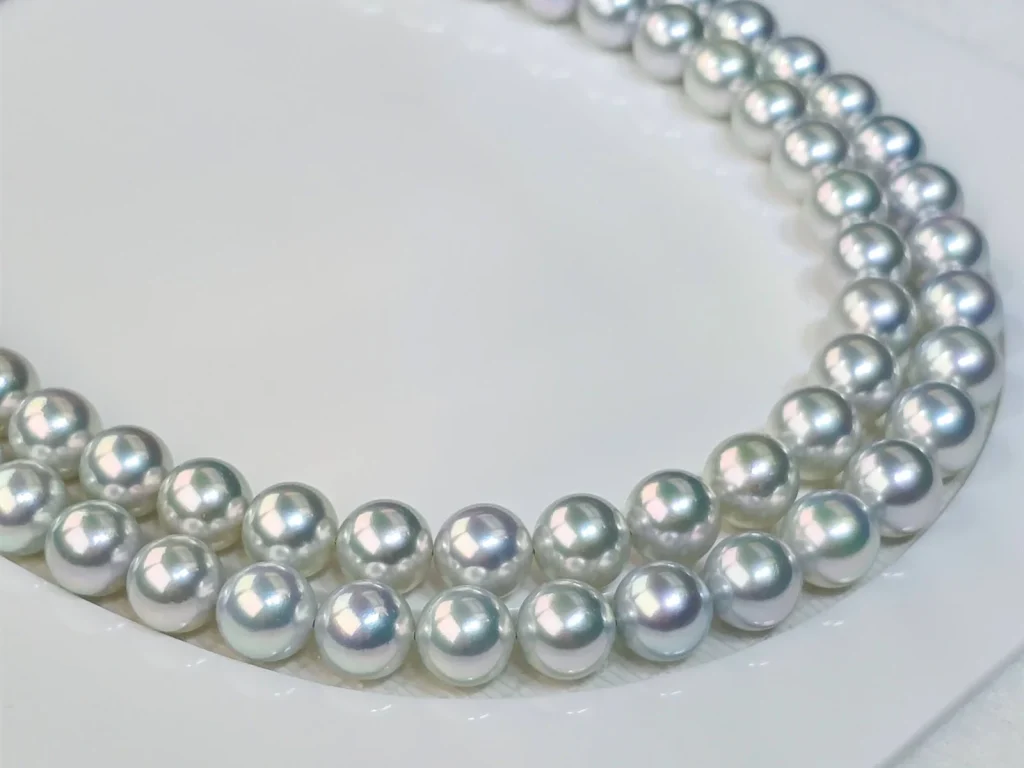
Natural blue Akoya are among the rarest Akoya of all. They are not a separate variety or a treatment: they come out of the same oysters, in the same harvests, as white Akoya.
How natural blue Akoya form
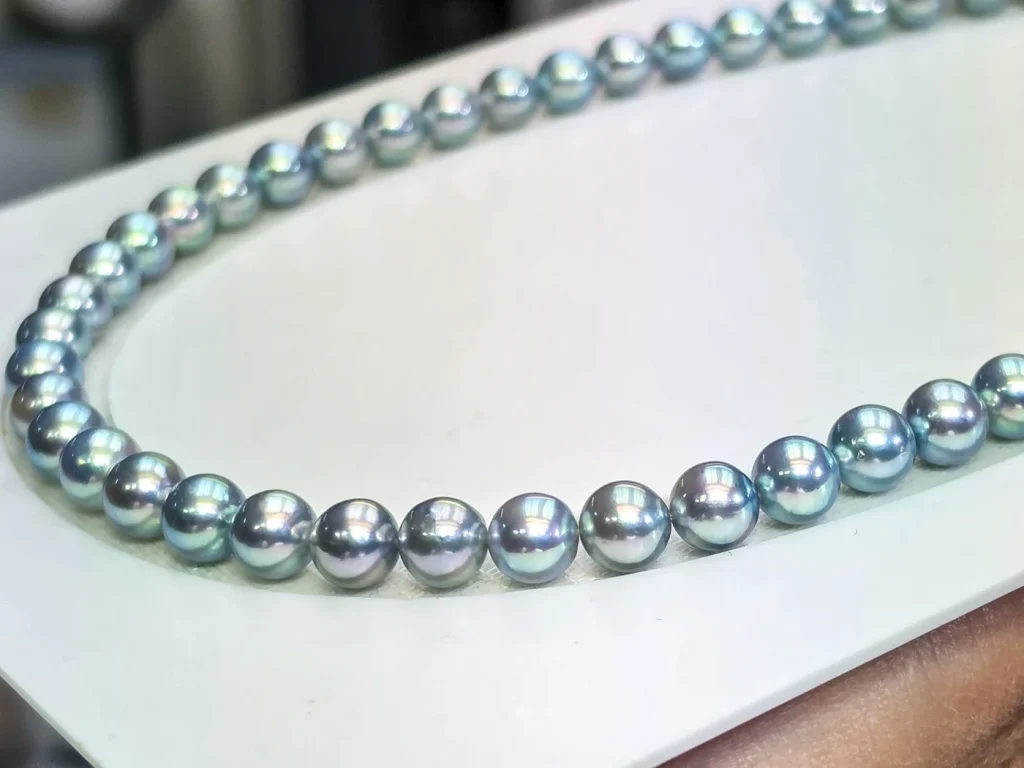
The blue comes from dark organic material, mostly conchiolin (the protein that binds nacre together), deposited between the bead and the nacre or within the inner nacre layers. Seen through the translucent nacre on top, that dark layer reads as silver-blue to blue-gray. Nothing in farming can reliably produce it, so it turns up in only a small share of each harvest, and the colors and tones vary from pearl to pearl.
That makes matching a full strand slow: blues have to be collected and sorted across harvests to line up color, tone and luster.
Madama and Blue Rosé: PSL’s natural blue designations
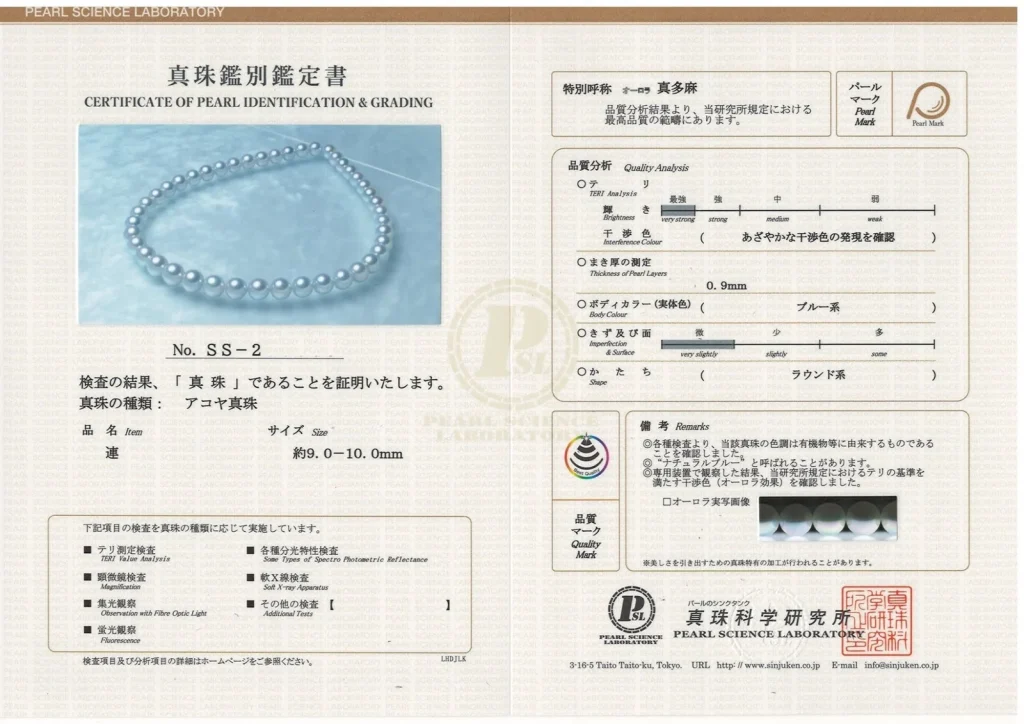
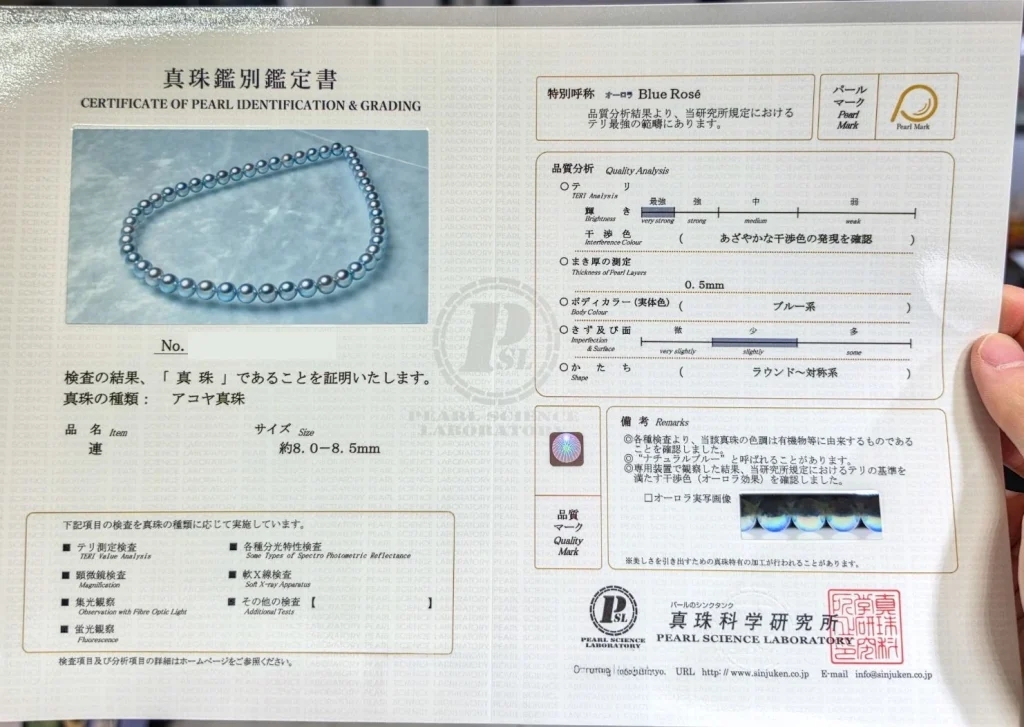
For natural blue Akoya, PSL adds a special designation to its report, much as Hanadama and Tennyo do for white Akoya. Two of these are Aurora Madama and Aurora Blue Rosé, and Madama ranks higher. PSL places a Madama strand in its highest-quality category, and a Blue Rosé strand in its strongest-luster (teri) category. Both reports confirm the blue comes from organic material in the pearl, the finding that marks a natural blue.
Here is what the two reports record. Read it alongside the note above: the lines below don’t capture matching across the strand, which is where Madama pulls ahead.
| Report line | Aurora Madama | Aurora Blue Rosé |
|---|---|---|
| Rank | Higher | Below Madama |
| Designation | Highest-quality category | Strongest-luster category |
| Size | 9.0–10.0 mm | 8.0–8.5 mm |
| Luster (teri) | Very strong | Very strong |
| Interference color | Vivid, confirmed | Vivid, confirmed |
| Nacre thickness | 0.9 mm | 0.5 mm |
| Body color | Blue | Blue |
| Blemishes | Very slight | Slight |
| Shape | Round | Round to symmetrical |
| Color origin | Organic material (“natural blue”) | Organic material (“natural blue”) |
Frequently asked questions
AAA is usually a seller's top grade for Akoya: high luster, clean surfaces, round shape and close matching. There is no industry-wide standard, though, so one company's AAA can be another's AA. Compare strands side by side or ask for a lab report.
No. A, AA and AAA grades are set company by company. For a grade that means the same thing from seller to seller, look for a lab report such as Pearl Science Laboratory's (PSL) Rose, Premium Rose, Hanadama or Tennyo certification.
Natural blue Akoya are Akoya pearls whose silver-blue to blue-gray color comes from dark organic material, mostly conchiolin, deposited between the bead and the nacre or within the inner nacre. They appear in only a small share of each harvest and are not dyed.
Madama (Aurora Madama) is a Pearl Science Laboratory (PSL) special designation for natural blue Akoya. Its numbered report places the strand in PSL's highest-quality category and confirms the blue comes from organic material in the pearl. Madama ranks above Blue Rosé: its strands are more closely matched and very clean.
Blue Rosé (Aurora Blue Rosé) is a Pearl Science Laboratory (PSL) special designation for natural blue Akoya. Its numbered report places the strand in PSL's strongest-luster (teri) category and confirms the blue comes from organic material in the pearl. It ranks below Madama, with slightly more imperfections and less consistent color.
Most Akoya pearls are 6–8 mm. Smaller sizes are common, while Akoya above 10 mm are rare and command a premium.
More pearl grading guides
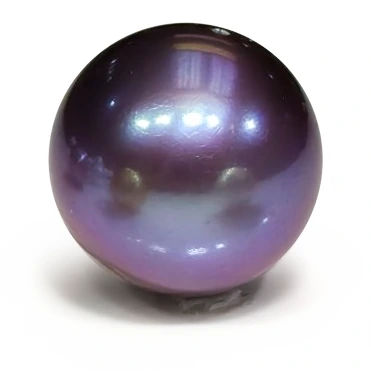
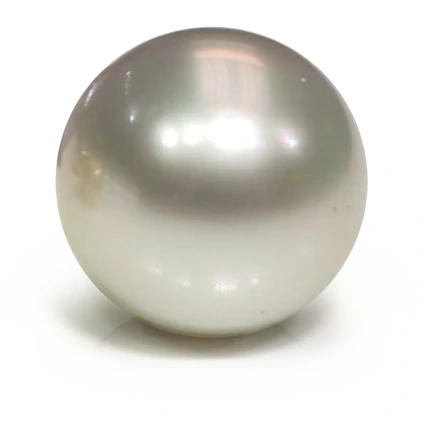 Golden & whiteSouth Sea PearlsThe history, colors and waters of the world’s largest cultured pearls.Read the guide
 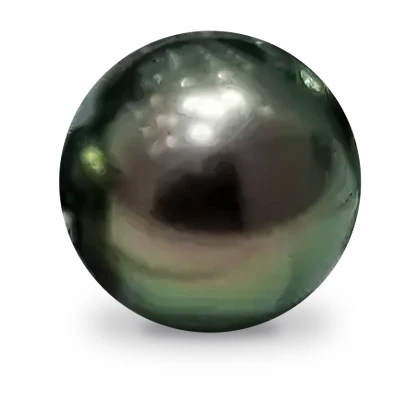 Black-lip oysterTahitian PearlsThe history, colors and lagoons of French Polynesia’s black pearls.Read the guide Care · Every pearl typePearl CareHow to wear, clean and store pearls, what keeps their luster and color, and the mistakes to never make.Read the guide