
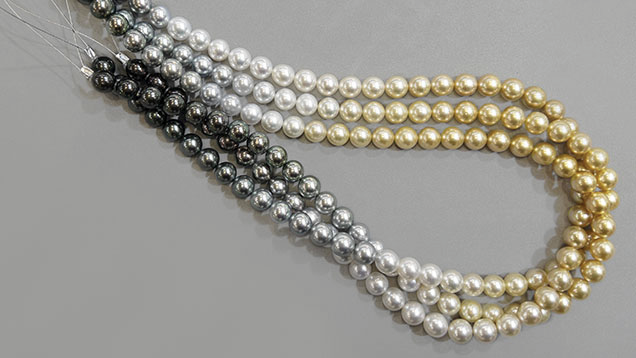
Tahitian pearls are the world’s naturally dark pearls, grown in the black-lip oyster in the lagoons of French Polynesia. This guide covers their history, how they are grown, the atolls they come from, and the colors and sizes that make them unlike any other pearl.
A short history
Polynesians valued the black-lip oyster long before pearl farming, carving its shell into fishhooks, tools and ornaments. Natural black pearls turned up only rarely and were treasured. Then came a century of shell diving, a bold experiment in the 1960s, and one of the fastest-growing pearl industries in the world.
- 1800s–1900sThe shell tradeDivers harvest the wild oyster beds for mother-of-pearl, shipped to Europe for buttons. Over-harvesting leaves many lagoons nearly bare.
- 1961The first graftsAfter earlier attempts in Japan failed, Jean-Marie Domard begins grafting black-lip oysters in French Polynesia.
- 1965The first harvestThe first cultured Tahitian pearls are harvested.
- 1970sFarms spreadFarms open across the Tuamotu atolls. Dealer Salvador Assael helps introduce the pearls to New York, and gemologists confirm their color is natural.
- 1990sBoom and glutRapid growth floods the market with pearls, and prices fall.
- 2000sA shakeoutNacre rules and a global downturn close many farms. The industry consolidates.
- 2017New rulesFrench Polynesia reforms its pearl regulations and ends the minimum nacre check at export.
How Tahitian pearls are grown
Tahitian pearls begin with wild oysters from the lagoon itself. Tap through the four stages.
Step 1 of 4
Collecting young oysters
Farmers hang collector lines in the lagoon, and wild baby oysters, called spat, settle on them. They grow for about two years before they are ready for grafting.
Step 2 of 4
Grafting
A technician places a round shell bead inside the oyster with a small piece of tissue from a donor oyster. The donor is chosen for the color of its inner shell rim, which carries into the pearl’s color.
Step 3 of 4
Growing
The oysters hang in the lagoon for 18 months to two years, cleaned regularly to keep them healthy, while nacre builds up layer by layer.
Step 4 of 4
Harvest
The pearl is removed. A healthy oyster that produced a good pearl can be grafted again in the same pearl sac, often producing a larger pearl the second time.
Because the oysters start life in the wild, the health of each lagoon sets a natural limit on how many pearls it can produce.
The lagoons
Tahitian pearls grow in the turquoise lagoons of coral atolls: rings of reef and low islands around a sheltered pool of seawater. The lagoon water is warm and clear and fed by the open ocean, carrying the plankton the oysters filter to feed. Warm water also means the oyster lays down nacre faster than the Akoya does in Japan’s cooler seas.
| Archipelago | What to know |
|---|---|
| Tuamotu | A long chain of coral atolls and the heart of production. |
| Gambier | A smaller, remote group to the southeast, known for its farms. |
| Society Islands | Home of Tahiti itself, and of Papeete, where the pearls are traded and exported. |
Farms depend on healthy lagoons for years at a time, so the industry has a direct stake in keeping them clean. Waste from farm gear and warming seas are the main concerns today.
Colors
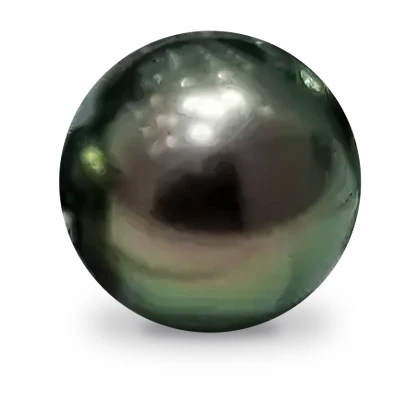
Tahitian pearl color has two parts. The body color is the main color you would name from across a room. The overtone is a second color that floats over it and shifts as the pearl turns. Both are natural. Mix a body color and an overtone to see how they combine.
1. Body color
2. Overtone
Peacock over charcoal
Charcoal is the classic dark gray, and a great base for any overtone. Peacock is a shimmer of green, gold and rose, the most sought-after overtone.
| Body color | Common overtones |
|---|---|
| Silver and light gray | Blue, rose, silver |
| Charcoal and dark gray | Blue, peacock, green |
| Green | Peacock, rose, pistachio |
| Aubergine | Peacock, rose, cherry |
| Near black | Green, blue, peacock |
Sizes
Most Tahitian pearls fall between 8 and 13 mm, and the largest share of the harvest is 10 to 13 mm. Pearls past 15 mm are uncommon, and the largest reach around 18 mm. Strands are often graduated, with smaller pearls near the clasp and larger ones at the front. Slide to compare sizes with a classic 7 mm Akoya.
| Size | What to expect |
|---|---|
| 8–10 mm | Smaller for the type: studs, pendants and finer strands. |
| 10–13 mm | The core of the harvest, with the widest choice. |
| 13–15 mm | Statement pieces; fewer to choose from. |
| 15 mm and up | Uncommon, priced as individual pieces. |
What to look for
A quick guide when choosing Tahitian pearls. For the full method, see the seven pearl value factors.
- Color and overtone: they move Tahitian prices more than any other type. Look for a vivid, even overtone.
- Luster: a bright, iridescent surface rather than a flat or chalky one.
- Surface: small marks are normal; judge them by where they sit.
- Size and shape: rounder and larger costs more, but circled and baroque pearls offer great value.
- Matching: for strands and pairs, check that body color and overtone agree.
Frequently asked questions
Tahitian pearls are grown in the black-lip oyster in French Polynesia, mostly on the coral atolls of the Tuamotu and Gambier archipelagos. They are named for Tahiti, the main island and trading hub, though few are grown there.
Yes. Their dark color comes from the black-lip oyster itself, carried into the pearl by tissue from a donor oyster chosen for its shell color. Black pearls from other sources are usually dyed or treated.
Peacock is an overtone: a green, gold and rose shimmer over a dark body color. It is not a body color, so the best descriptions name both, such as peacock over green.
Most are 8 to 13 mm, and the largest share of the harvest is 10 to 13 mm. Pearls over 15 mm are uncommon, and the largest reach about 18 mm.
More pearl guides
 Golden & whiteSouth Sea PearlsThe history, colors and waters of the world’s largest cultured pearls.Read the guide