
How we and the trade actually grade cultured pearls, type by type. This is written for buyers who want the real vocabulary, not marketing language: the same terms you’ll see on our certificates and in our listings.
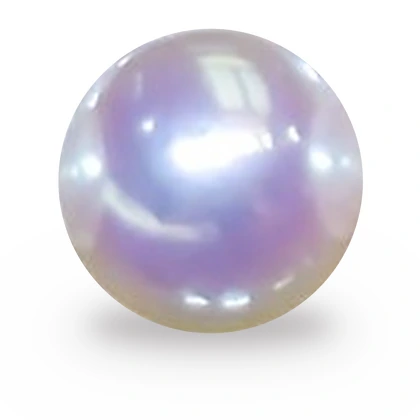
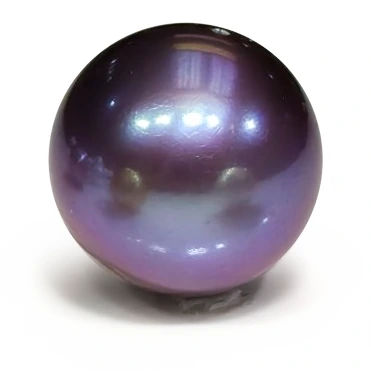
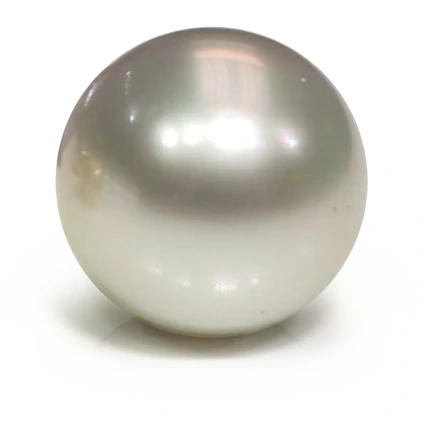 Golden & whiteSouth Sea PearlsThe history, colors and waters of the world’s largest cultured pearls.Read the guide
 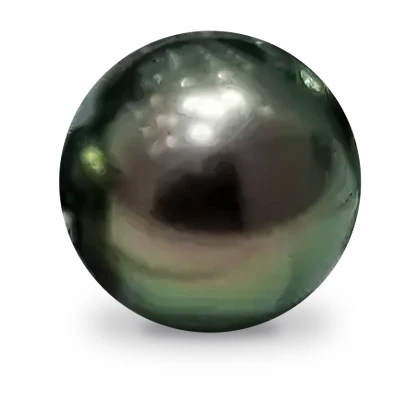 Black-lip oysterTahitian PearlsThe history, colors and lagoons of French Polynesia’s black pearls.Read the guide Care · Every pearl typePearl CareHow to wear, clean and store pearls, what keeps their luster and color, and the mistakes to never make.Read the guide
 The 4Cs of pearls: seven value factors
Diamonds are graded on the 4Cs: carat, clarity, color and cut. Pearls have their own version with seven parts, called the pearl value factors, the same system GIA uses on its pearl reports. Every pearl grade, from a seller’s A–AAA letter to a numbered lab certificate, comes down to these seven.
If you already know the 4Cs, four of the factors will feel familiar. The other three have no diamond equivalent, and one of them, luster, matters more than anything else.
| Diamond 4Cs | Pearl factor | What’s different |
|---|---|---|
| Carat | Size | Pearls are measured across in millimeters, not by weight. |
| Clarity | Surface | Judged by eye, and where a mark sits matters more than how many there are. |
| Color | Color | Pearls add overtone and orient on top of the main color. |
| Cut | Shape | A pearl’s shape is grown, not cut. Round is the rarest. |
| Not in the 4Cs | Luster, nacre, matching | Unique to pearls. Luster leads pearl value. |
Explore the seven factors
Tap a factor to see what it means, what good looks like and how to check it at the bench. They are numbered in the order we judge them.
Factor 1 of 7 · Judged first
Luster
How much light a pearl reflects, and how sharp that reflection is. Japanese buyers call it teri (テリ). It moves value more than any other factor.
- ExcellentBright and mirror-sharp. You can make out shapes in the reflection.
- Very good / GoodBright, with edges that are slightly soft.
- FairA glow with blurry edges.
- PoorDim and hazy. A chalky or milky look warns of thin or poor nacre.
How to check it
Hold the pearl under your light and look at the reflection of the bulb, or of your own face. Judge the edges of the reflection, not just how bright it is.
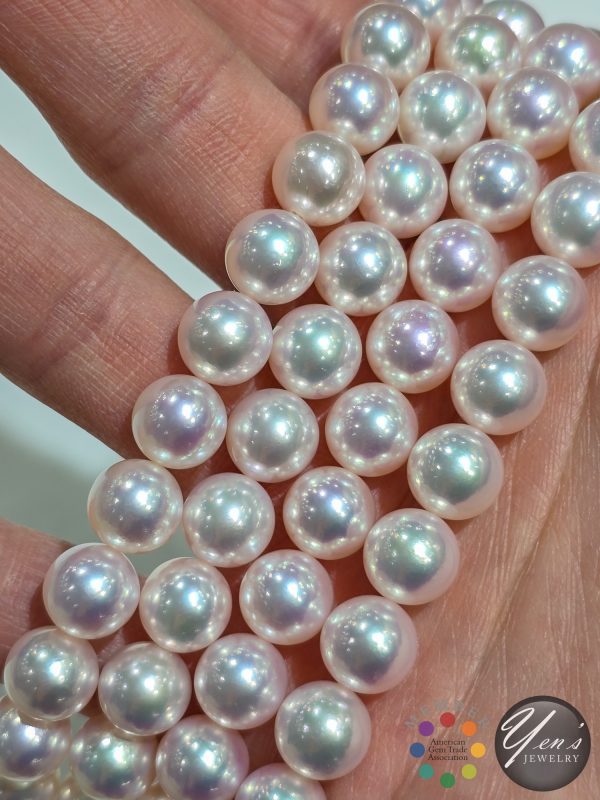
What good looks like by type: fine Akoya is mirror-sharp. South Sea has a broad, satiny glow. Tahitian shows a softer reflection with iridescence over it. Most freshwater is softer still, though top Edison pearls can look metallic.
Factor 2 of 7
Nacre
The layered pearl material built up around the bead or tissue. How thick and how dense it is decides how a pearl glows and how long it lasts.
How to check it
- Look into the drill hole with a loupe. You can often see where the nacre meets the bead.
- Watch for “blinking.” Roll a beaded pearl under the light. If the bead’s banding flashes through, the nacre is too thin.
- Ask for a lab measurement. Labs measure nacre by X-ray. PSL requires at least 0.4 mm for Aurora Hanadama®.
Nacre matters most in Akoya, where the layer is thinnest. Dense nacre, grown slowly in cold water, reflects more sharply than thick but loose nacre grown fast in warm water. South Sea and beaded freshwater pearls usually carry several millimeters.
Factor 3 of 7
Shape
Round pearls are the hardest to grow, so they cost the most. Other shapes are not lower quality; they suit different jewelry and give you size and luster for less.
How to check it
Roll the strand slowly on a flat tray. Round pearls roll straight and evenly; off-round pearls wobble. For a single pearl, measure across it in a few directions with your gauge.
Factor 4 of 7
Color
Pearl color has three parts, and a good description names each one. Color is described rather than ranked: the best color is the one your customer wants.
How to check it
Look at the pearls on white under soft light: from arm’s length for bodycolor, then up close for overtone and orient. In Tahitian pearls, “peacock” is an overtone, not a bodycolor, so a full description names both.
Natural or treated? Some processing is standard; nearly all Akoya are bleached for even color. Dyeing must be disclosed. Dye collects in drill holes and surface marks, so check both with a loupe. A strand where every pearl is exactly the same color is also a flag. Black Akoya are always dyed.
Factor 5 of 7
Surface
Almost every pearl has some spots, pits or bumps. Grade them by size, depth, number and, most of all, where they sit.
How to check it
Roll the strand slowly through a full turn so you see every side of every pearl. Use the loupe on anything that catches your eye. A mark beside the drill hole hides under the next pearl; the same mark on the face does not.
Factor 6 of 7
Size
Measured across in millimeters. Size only means something next to the type: a 10 mm Akoya is exceptional, while a 10 mm South Sea pearl is entry level.
How to check it
Measure with a gauge. Strands are sold as a range, such as 7.0–7.5 mm. Fine strands are sorted in half-millimeter steps; a full-millimeter range, such as 7.0–8.0 mm, usually means a looser sort.
Price climbs much faster than size, so each extra half millimeter costs more than the one before.
Factor 7 of 7 · Strands and pairs
Matching
How closely the pearls in a strand or pair agree in size, shape, color, overtone, luster and surface.
One pearl is off: the seventh from the left is a little smaller and warmer in tone. That is exactly what you look for down a strand.
How to check it
Lay the strand straight on the tray and look down its length; any pearl that differs will stand out. For earrings, set the pair side by side at the same angle.
The finest strands are mirror-matched: the third pearl from the clasp on one side matches the third on the other. Building one can take pearls from several harvests, which is why a strand is worth more than its pearls sold one by one.
Grading scales you’ll see
There is no single grading system that every seller uses. These are the ones you are most likely to meet, and what each one actually tells you.
| Scale | Used for | What to know |
|---|---|---|
| A–AAA (and AAAA) | Akoya and freshwater | Set by each seller. One company’s AAA can be another’s A, so compare pearls, not letters. |
| A–D | Tahitian | French Polynesia’s system. It grades surface and luster, not color. |
| GIA report | All types | Describes each of the seven factors and confirms natural or treated color. |
| PSL certificate | Akoya and other types | Numbered report with published criteria, including Aurora Hanadama® and Aurora Tennyo®. See Hanadama & Tennyo. |
A quick bench checklist
- Set the pearls on a white tray under soft, even light.
- Check luster first: look for a sharp reflection, and note any chalky pearls.
- Look into a few drill holes for nacre thickness, and roll beaded pearls to check for blinking.
- Roll the strand on the tray to judge shape and see every side for surface marks.
- Read bodycolor from arm’s length, then overtone and orient up close. Check drill holes for pooled dye.
- Measure with a gauge and confirm the size range.
- Lay the strand straight and look down it for any pearl that doesn’t match.
- Ask for paperwork: a lab report where it matters, and a clear statement of natural or treated color.
The four types at a glance
| Type | Grown in | Usual size | What moves value most |
|---|---|---|---|
| Akoya | Akoya oyster (Pinctada fucata) | Mostly 6–8 mm; above 10 mm is rare | Luster first, then surface, shape and nacre |
| Freshwater | Triangle-sail mussel, grown two ways: | ||
| Traditional | Tissue only, no bead | Small to medium | Roundness, luster and surface |
| Edison | With a bead | Mostly 6–12 mm; 13–16 mm and up available | Luster, size and natural color |
| South Sea | Pinctada maxima | Golden 9–16 mm; white 10–16 mm | Golden: depth of color. White: size |
| Tahitian | Black-lip oyster (Pinctada margaritifera) | 8–13 mm | Color and overtone |
Frequently asked questions
Luster. It moves value more than any other factor, and poor luster often signals thin or poor nacre. Size, surface, shape and matching follow, with the order shifting by pearl type.
Not necessarily. A–AAA scales are set by each seller, so one company’s AAA can match another’s A. Compare the pearls themselves, or rely on a lab report such as PSL or GIA when the grade matters.
Look into the drill hole with a loupe for the line where nacre meets the bead, and roll the pearl under light to check for blinking. A lab can measure nacre with X-ray; PSL requires at least 0.4 mm for Aurora Hanadama®.
Some processing is standard, such as bleaching Akoya for even color. Dyed color must be disclosed and is valued below natural color. Check drill holes and surface marks for pooled dye, and ask for a natural color statement.