
Freshwater pearls grow in mussels in lakes, ponds and rivers, and today nearly all of them come from China. There are two ways to grow them: the traditional method, which uses only a sliver of tissue, and the modern method, which adds a bead and produces what the trade calls Edison pearls. This guide covers both methods, the history, where they grow, and the colors and sizes you can expect.
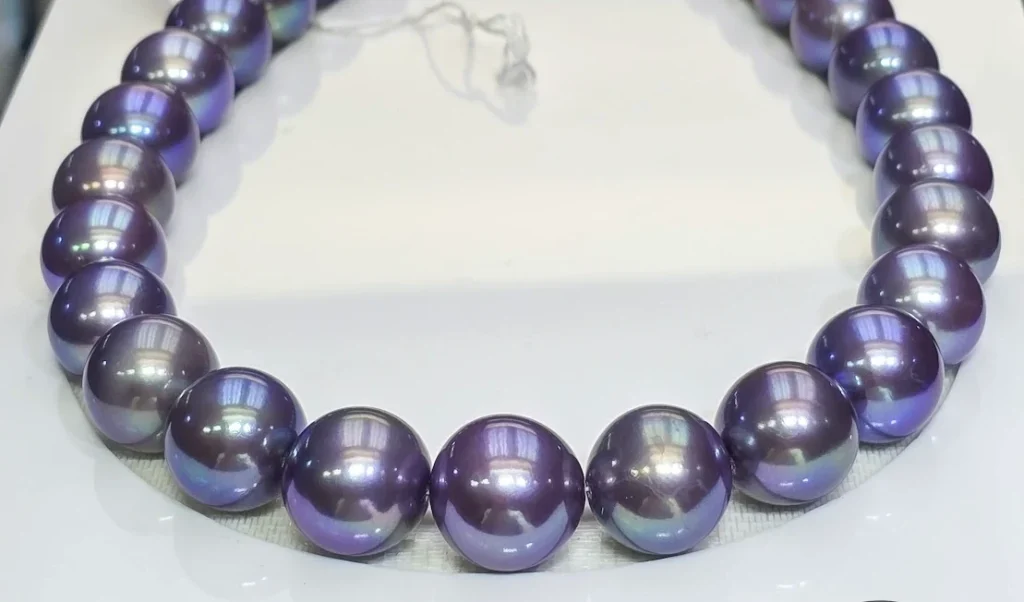
Two ways to grow a freshwater pearl
| Traditional (tissue-nucleated) | Modern Edison (bead-nucleated) | |
|---|---|---|
| What starts the pearl | A small piece of mantle tissue only | A shell bead placed with the tissue |
| Inside | Solid nacre throughout | Nacre over a bead, usually several millimeters thick |
| Typical shapes | Potato, button, oval, baroque; truly round is rare | Round and near-round |
| Typical sizes | Small to medium | Most 6–12 mm; 13–16 mm and larger available |
| Luster | Soft, satiny glow | From soft to strongly metallic in the finest |
| What the trade calls it | Usually just “freshwater pearls” | Edison (also sold as Ming, Ikecho) |
Traditional freshwater pearls (tissue-nucleated)
This is the original way freshwater pearls are cultured, and when the trade simply says “freshwater pearls,” this is usually what it means.
How they are grown
No bead, just tissue. Tap through the four stages.
Step 1 of 4
The donor mussel
A technician cuts small squares of mantle tissue from a donor mussel. The donor’s shell color helps set the color of the pearls.
Step 2 of 4
Grafting
The squares are slipped into small slits along both mantle lobes of a host mussel. No bead is used, and one mussel can take many grafts at once.
Step 3 of 4
Growing
Each piece of tissue forms a pearl sac that coats itself, layer by layer, with nacre. The mussels hang in ponds and lakes for several years.
Step 4 of 4
Harvest
A single mussel can yield dozens of pearls, in every shape from near-round to baroque. They are then sorted by size, shape, color and luster.
What they look like
- Solid nacre: with no bead inside, the pearl is nacre all the way through, so it can’t chip down to a bead.
- Shape: without a round bead to follow, most grow off-round. The trade calls the common shapes potato (slightly flattened ovals), button, rice and baroque. Truly round traditional pearls are rare.
- Luster: a soft, satiny glow rather than a hard mirror shine, with the finest showing strong luster.
- Color: natural whites and pastels such as pink, peach and lavender.
A brief history of freshwater pearl culturing
- 1200sChina: the first cultured pearlsFreshwater blister pearls: tiny figures such as Buddhas placed against the inside of a mussel shell and coated with nacre. The technique is credited to Yu Shun Yang.
- Early 1900s–1980sJapan: Lake BiwaTissue-nucleated culturing is developed in Lake Biwa. “Biwa pearls” become famous for their luster and organic shapes, until pollution ends production in the lake.
- 1960s–1990sChina scales upEarly pearls are small and wrinkled (the trade calls them “rice krispies”), but quality, size and roundness improve, especially after farms move to the triangle-sail mussel.
- 2000s–2010The bead returnsBead nucleation in freshwater mussels produces large, round pearls, sold as Edison pearls.
- TodayTwo methods, side by sideChina grows most of the world’s freshwater pearls. Traditional tissue-nucleated pearls are still grown alongside Edison pearls.
Where they grow
Freshwater pearl farming is centered in eastern China, especially Zhejiang province, where the town of Shanxiahu near Zhuji is the industry’s trading capital. Mussels are hung in nets or baskets from floating lines in ponds and lakes, a few feet below the surface.
A mussel feeds by filtering the water around it, so the health of the pond decides the health of the pearls. Clean water and plenty of plankton build better nacre and stronger color. Over the past decade, tighter water quality rules have moved much of the industry out of open lakes and rivers and into managed ponds, and many farms raise fish in the same ponds.
Colors
Freshwater pearls grow naturally in soft whites and pastels. The donor mussel’s shell color steers the color of each pearl. Tap a color to see it.
Choose a color
White
The most common color. White freshwater pearls are routinely bleached for an even tone, a long-standard and generally accepted practice.
| Color | What to know |
|---|---|
| White | The most common color. Routinely bleached for an even tone, a long-standard and generally accepted practice. |
| Pink | A soft, natural blush. Deeper, even pink costs more. |
| Peach | Warm apricot to salmon. Common and natural. |
| Lavender | Pale violet to lilac. Deep purples are rarer and mostly Edison pearls. |
Sizes
Traditional freshwater pearls run from tiny seed pearls to large baroques. Slide to compare with a classic 7 mm Akoya. For large, round pearls, see Edison sizes.
What to look for
A quick guide when choosing traditional freshwater pearls. For the full method, see the seven pearl value factors.
- Luster: a bright, even glow across the strand. Avoid chalky or dull pearls.
- Shape: round is rarest and costs most; near-round, potato, button and baroque step down in price.
- Surface: fewer and smaller blemishes. Check where pearls touch on the strand.
- Color: even, matched color across a strand adds value.
- Matching: pearls in a strand should agree in size, shape, color and luster.
Frequently asked questions
Both grow in freshwater mussels. Traditional freshwater pearls are tissue-nucleated with no bead, so they are solid nacre and usually off-round, potato or baroque in shape. Edison pearls are bead-nucleated, the modern method, which produces larger, rounder pearls.
Traditional tissue-nucleated freshwater pearls are solid nacre all the way through, because no bead is used. Bead-nucleated Edison pearls have nacre over a bead, usually several millimeters thick.
Without a round bead to grow around, a tissue-nucleated pearl forms freely inside the mussel, so most come out slightly off-round. The trade calls these potato, button or baroque shapes. Truly round traditional freshwater pearls are rare.
The earliest known cultured pearls were freshwater blister pearls made in China in the 1200s. Tissue-nucleated freshwater culturing was developed in Japan's Lake Biwa in the early 1900s and taken up on a large scale in China from the 1960s.
More pearl guides
 Golden & whiteSouth Sea PearlsThe history, colors and waters of the world’s largest cultured pearls.Read the guide
  Black-lip oysterTahitian PearlsThe history, colors and lagoons of French Polynesia’s black pearls.Read the guide Care · Every pearl typePearl CareHow to wear, clean and store pearls, what keeps their luster and color, and the mistakes to never make.Read the guide