
Hanadama and Tennyo are the two most talked-about names in Akoya pearls, and two of the most misused. This guide explains what each one actually certifies, how Pearl Science Laboratory (PSL) grades them, and what to check on a certificate before you buy.
Part of our Akoya pearl guide.
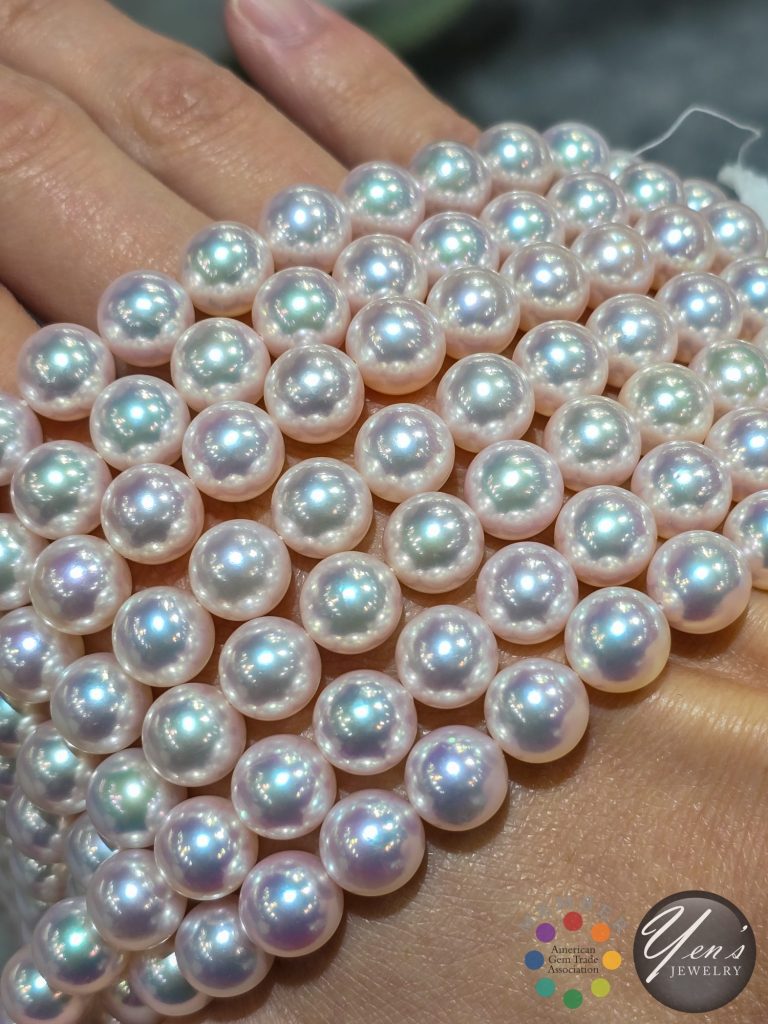
What does “Hanadama” mean?
Hanadama (花珠), “flower pearl,” is a historical Japanese trade term for the best white Akoya of a harvest. On its own it has no fixed definition: several Japanese labs certify their own version of it, and they are not equivalent to each other. A “Hanadama” claim without a lab name behind it tells you very little.
PSL (真珠科学研究所) issues the trade’s most widely recognized standardized grading for Akoya pearls. It solved the definition problem in 2000 by publishing the first standardized criteria and certifying its version as Aurora Hanadama®. It isn’t a grade above Hanadama. It’s Hanadama with published, testable criteria and a numbered report.
PSL’s certified tiers for Akoya
PSL’s certified grades for white Akoya run in four tiers, from entry level to the top:
| Tier | Where it sits |
|---|---|
| Rose | PSL’s entry certified tier |
| Premium Rose | A step above Rose |
| Hanadama | Aurora Hanadama®: PSL’s standardized Hanadama, with the published criteria below |
| Tennyo | Aurora Tennyo®: a further selection within Hanadama, judged on luster and color alone |
Every tier comes with a numbered PSL report. For natural blue Akoya, PSL’s highest grade is Madama; see natural blue Akoya. For uncertified Akoya and the A–AAA scale, see the Akoya pearl guide.
Aurora Hanadama® grading criteria
| Factor | Requirement |
|---|---|
| Size | 6.0 mm and up |
| Nacre thickness | 0.4 mm minimum |
| Shape | PSL’s Round series (ラウンド系) |
| Surface | Flaws rated “minimal” (微) on PSL’s internal scale |
| Luster | Weighted most heavily: brilliance and interference color judged against PSL’s master set |
Meeting all five doesn’t automatically mean Hanadama. PSL treats its Highest Quality band as narrow rather than a broad pass/fail line: if luster lands at the very top of the internal scale, the pearl is promoted to Aurora Tennyo® instead.
 Rare collectibleHanadama at 11–12 mmAn Aurora Hanadama® strand far above the 6 mm minimum, with luster rated strongest.
What are Tennyo pearls? Aurora Tennyo® explained
Aurora Tennyo (オーロラ天女), “celestial maiden,” is PSL’s further selection within Aurora Hanadama, judged on luster and color alone. It requires luminance distribution of 90% or more of the highest recorded value, and three or more colors visible, red through green, in the pearl’s interference pattern.
Every Tennyo report includes a photograph of that specific strand’s unique “Aurora Effect” pattern, discovered by PSL founder Hiroshi Komatsu in 2001: the shifting interference color that appears on a pearl’s lower hemisphere under diffused light. Because nacre structure differs microscopically from pearl to pearl, that pattern is unique. It works like a fingerprint that ties the photo to the certificate.
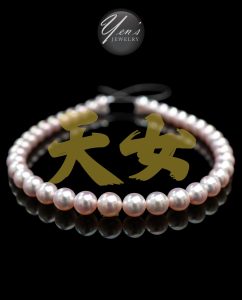 See the real thingAurora Tennyo® strands and a real certificatePhotos of our Tennyo strands showing teri up close, and PSL’s sample report explained point by point.
 Rare collectibleHow big can Tennyo get?A 10.5–11.3 mm Aurora Tennyo® strand: two rarities in one, and fewer than ten believed to exist.
Hanadama vs. Tennyo vs. GIA “hanadama”
| Aurora Hanadama® (PSL) | Aurora Tennyo® (PSL) | GIA “hanadama” comment | |
|---|---|---|---|
| Judged on | Size, nacre, shape, surface and luster | Luster and color, within Aurora Hanadama | Mainly surface cleanliness |
| What it is | PSL’s standardized Hanadama | A further PSL selection, not a separate ladder | A different lab’s separate designation |
| Proof | Numbered PSL report | Numbered PSL report with the strand’s Aurora Effect photo | Comment on a GIA report |
A GIA “hanadama” comment is a separate designation judged mainly on surface cleanliness, not the same standard as PSL’s. Every GIA-hanadama strand would also clear Aurora Hanadama, but not the reverse. And even within one certified tier, price can still vary several-fold depending on where above the threshold a given strand sits.
Frequently asked questions
Hanadama (花珠, "flower pearl") is a Japanese trade term for the best white Akoya pearls of a harvest. On its own it has no fixed definition, so look for the certifying lab's name. Pearl Science Laboratory (PSL) certifies its standardized version as Aurora Hanadama®.
Aurora Tennyo® is a further PSL selection within Aurora Hanadama®, judged on luster and color alone. A strand is promoted to Tennyo when its luster reaches the very top of PSL's scale and its interference pattern shows three or more colors.
No. GIA's hanadama comment is a separate designation judged mainly on surface cleanliness. It is not the same standard as PSL's Aurora Hanadama®, which also sets size, nacre, shape and luster requirements.
PSL requires a size of 6.0 mm and up, nacre at least 0.4 mm thick, a shape in PSL's Round series, surface flaws rated "minimal," and strong luster, which is weighted most heavily.
Tennyo follows the usual Akoya size range, so strands above 10 mm are extremely rare; we document a 10.5 to 11.3 mm strand in our Rare Collectibles section.
More pearl grading guides
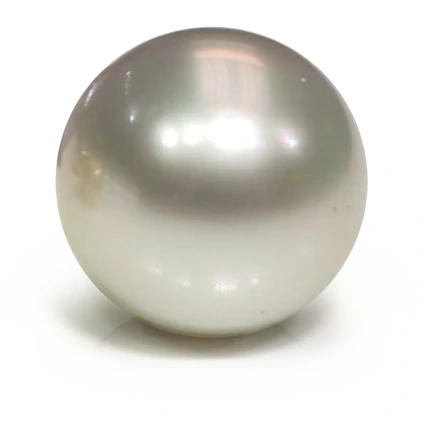 Golden & whiteSouth Sea PearlsThe history, colors and waters of the world’s largest cultured pearls.Read the guide
 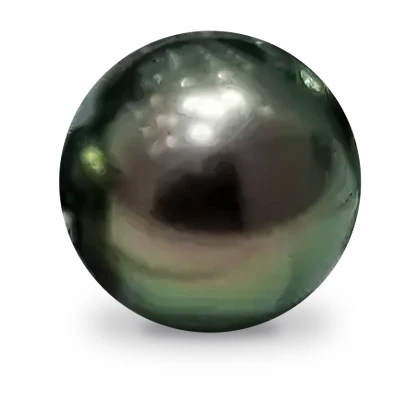 Black-lip oysterTahitian PearlsThe history, colors and lagoons of French Polynesia’s black pearls.Read the guide Care · Every pearl typePearl CareHow to wear, clean and store pearls, what keeps their luster and color, and the mistakes to never make.Read the guide