
Edison pearls are the modern way of growing freshwater pearls: a bead inside the mussel produces large, round pearls that the traditional method rarely could, in some of the most vivid colors on the market. This guide covers what the name means, how they’re grown, the natural colors and sizes, and what to look for.
Part of our freshwater pearl guide. For the traditional, tissue-nucleated method, see traditional freshwater pearls.
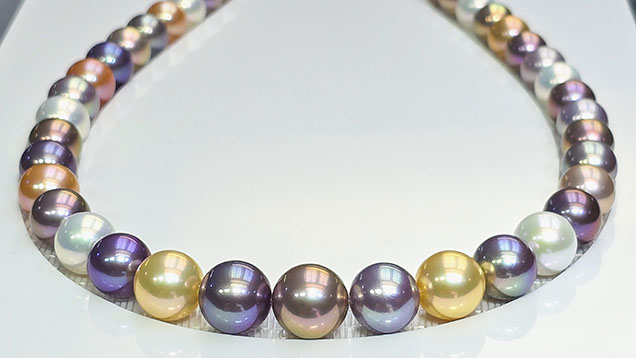
What are Edison pearls?
Edison, along with names like Ming and Ikecho, is a marketing brand applied to large, round, bead-nucleated freshwater pearls grown in Chinese triangle-sail mussels (Hyriopsis cumingii and hybrids). The names describe similar production methods, not distinct biology or an independent quality tier. Grade them on the same fundamentals as any bead-nucleated freshwater pearl.
A short history
Edison pearls are a recent chapter in a very old story. Freshwater pearls have been cultured in China for centuries, but for most of that time they grew from tissue alone and came out small and off-round. Adding a bead changed that. The longer history of freshwater pearls.
- 1960s–1990sFreshwater scales upChinese farms grow tissue-nucleated freshwater pearls on a large scale. Quality and size improve steadily.
- Early 2000sThe bead goes inGrowers in China develop bead nucleation for freshwater mussels, placing the bead deep in the mussel’s soft tissue.
- Around 2010Edison reaches the marketLarge, round, brightly colored freshwater pearls arrive under the Edison name, alongside Ming and Ikecho.
- Late 2023Small rounds masteredPerfectly round small white sizes, 2–7 mm, become consistent.
- TodayRounder, larger, more colorFarms push for round 6–10 mm whites, while natural purple and metallic colors in small sizes are newer to the market.
How Edison pearls are grown
An Edison pearl starts the way a traditional freshwater pearl does, with tissue from a donor mussel, then adds a bead. Tap through the four stages.
Step 1 of 4
Choosing the donor
Farms breed consistent mussel lines with ultra-white or deep purple inner shells. A sliver of mantle tissue from the donor steers the color and luster of the pearl.
Step 2 of 4
Bead and tissue
A bead and a piece of donor tissue go deep into the soft tissue of a host triangle-sail mussel, ideally at 7 to 8 months old, its most vigorous age.
Step 3 of 4
Years in the water
The mussels hang in farm ponds while nacre builds up around the bead. The finest grow for 3 to 4 years, which builds thick nacre and color that won’t fade.
Step 4 of 4
Harvest
Well-grown Edisons need only a rinse and a gentle polish. Heat treatment (maeshori) and optical brighteners can weaken nacre and strip natural color.
A mussel can carry a dozen to several dozen grafts and run more than one growing cycle, compared to just one or two per saltwater oyster. That single fact explains most of the price and availability gap between freshwater and saltwater pearls. For the original, bead-free method, see traditional freshwater pearls.
Colors
Edison pearls come in a wider range of natural colors than any other cultured pearl. Every color below is natural. The families run from the easiest to find to the rarest. Tap a family, then a pearl.
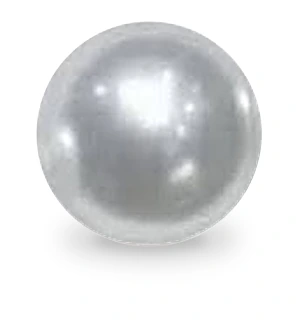
Whites
Porcelain White 瓷白
Clean, bright white with a cool, glassy glow.
The most widely grown Edison color and the base of most white strands. Compare the overtone: pink, blue or cream.
Whites 白色系
Purples 紫色系
Rose, Bronze & Gold 玫瑰、古銅與金色系
Metallic & Iridescent 金屬與幻彩系
All colors shown are natural. Every Edison pearl is unique, so shade and overtone vary from pearl to pearl. Chinese names are the trade names growers use.
Sizes
The bead is what gives Edison pearls their size. Slide to compare with a classic 7 mm Akoya.
Large sizes of 13–16 mm are also on the market, but genuine rarity kicks in when a pearl at that size is also round, carries a metallic overtone, or shows deep saturated color. Any one of those narrows the pool sharply, and having more than one pushes a pearl into real scarcity. We’ve also seen 18–20 mm examples surface, which are rarer still.
In the press: GIA opened its Tucson 2026 pearl market report with our multicolor Edison strand, and featured our 14–16 mm Edison strand in its 2023 Tucson overview.
 Rare collectibleTanzanite Blue & Amethyst Purple, up to 17.9 mmLarge, round, high-luster Edison strands in saturated color: what all four together look like.
From the farm: how Edison pearls are grown today
On our 2025 trip to Shanxiahu, China’s freshwater pearl capital, farmers walked us through how Edison pearls are grown now. The short version for buyers:
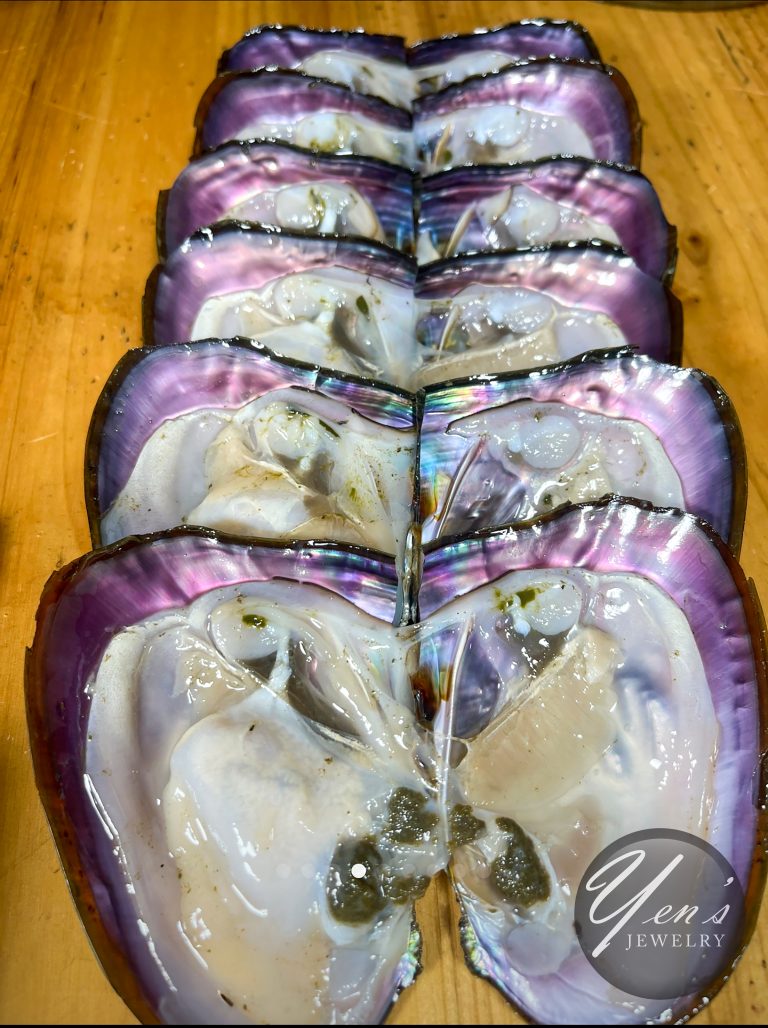
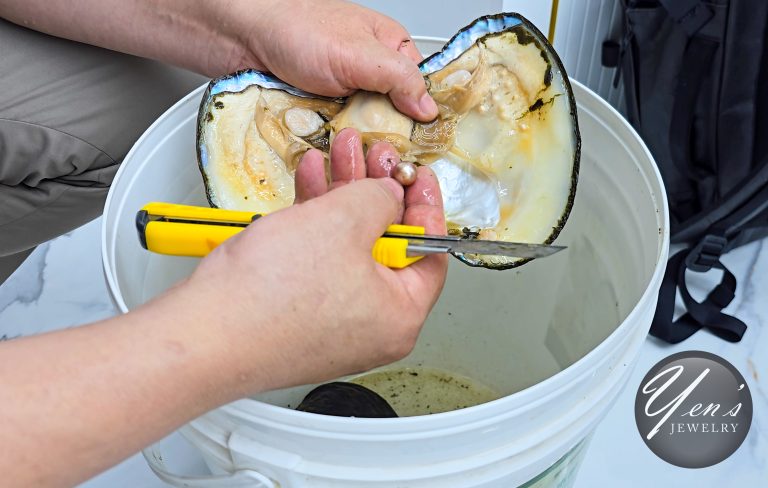
- A bead plus donor tissue. Edison pearls were developed in China in the early 2000s and reached the market around 2010. The bead is what lets freshwater mussels grow large, round pearls.
- Bred mussel lines. Farms now breed consistent mussel lines with white or deep purple inner shells as tissue donors, which shapes the color and luster of the pearls.
- Younger grafting. Mussels are now grafted at 7 to 8 months, their most vigorous age, instead of after a year; donor tissue from mussels 7 to 10 months old gives the best results.
- Small rounds, then bigger. Perfectly round small sizes were mastered by late 2023; farms are now pushing for round 6–10 mm whites.
- Years in the water. The finest Edisons grow for 3 to 4 years. That builds thicker nacre and, just as important, color that won’t fade. Pearls pulled early are the ones most likely to lose purple, lavender, pink or metallic tones.
- Little or no treatment. Well-grown Edisons need only a rinse and a gentle polish. Heat treatment (maeshori) and optical brighteners can weaken nacre and strip natural color.
Photos, videos and the full story: our Shanxiahu pearl farm report.
What to look for
A quick guide when choosing Edison pearls. For the full method, see the seven pearl value factors.
- Luster: the top factor. The finest show a sharp, near-mirror reflection, most often in naturally colored pearls.
- Size: drives value more than in most pearls. Expect a real step up in price from 12 mm.
- Shape: the method is built for round, so judge symmetry closely.
- Color: ask whether it is natural. Deep purple, bronze, copper and metallics are the rare ones.
- Surface and matching: look for clean surfaces, and in strands, pearls that agree in color and overtone.
Frequently asked questions
Edison pearls are large, round, bead-nucleated freshwater pearls grown in Chinese triangle-sail mussels (Hyriopsis cumingii and hybrids). "Edison" is a trade brand name, like Ming and Ikecho, not a separate species or grading system.
Yes. Edison pearls are cultured freshwater pearls: the mussel coats an inserted bead with its own nacre, usually several millimeters thick. The name describes the production method and the large, round pearls it produces.
Most Edison pearls run 6–12 mm, with 12 mm and up commanding a real premium. Sizes of 13–16 mm are on the market, and 18–20 mm pearls are rarer still. Bead-nucleation is now also mastered for small white pearls of 2–7 mm.
Many are. Natural whites and pastels such as pink, peach and lavender are common, while natural bronze, copper and deep purple are rare and worth more. Freshwater pearls are also often treated, so always ask whether the color is natural.
More pearl guides
 Golden & whiteSouth Sea PearlsThe history, colors and waters of the world’s largest cultured pearls.Read the guide
  Black-lip oysterTahitian PearlsThe history, colors and lagoons of French Polynesia’s black pearls.Read the guide Care · Every pearl typePearl CareHow to wear, clean and store pearls, what keeps their luster and color, and the mistakes to never make.Read the guide